

How to Choose the Right Sofa Color

Updated: Oct 20
[Editor’s Note: Blair recently shared her perspective with Homes & Gardens for its guide to choosing the right sofa color. We’ve expanded on that conversation here, exploring how we think about color, visual weight, longevity, and the role a sofa plays within a room.]
Choosing a sofa color can feel like one of the biggest decisions in a room—and in some ways, it is. A sofa is often the largest upholstered piece in a space, one of the more significant furniture investments, and something we hope will remain in a home for many years.
But we rarely begin by asking, What color should the sofa be?
We begin with a different question:
What does the sofa need to do for the room?
Does it need to anchor the space? Recede and allow the architecture to lead? Connect several other colors in the room? Or should the sofa itself become the statement?
Once that question is answered, choosing the color becomes much easier.
Don't Try to Match the Sofa to Everything Else
A sofa does not need to match the rug, curtains, or accent chairs. Those elements should have a relationship with one another, but a well-designed room is more interesting than a collection of perfectly coordinated pieces.

Photography: Julie Soefer / Styling: Jessica Holtam
Because the sofa is often the largest upholstered object in the room, we frequently allow it to provide a relatively quiet foundation and introduce more color and pattern through rugs, pillows, artwork, and occasional chairs.
Pillows are particularly useful as connective tissue. A pillow might pick up the rust of an accent chair, the blue in a rug, or a color from a painting. Those small connections help a room feel considered without requiring every element to match.
There is a practical advantage to this approach, too. A beautifully made sofa may remain in a home for decades. Pillows are much easier to change. A versatile sofa allows a room to evolve.
And neutral certainly does not have to mean anonymous. Some of the most distinctive sofas we have used are quiet in color but memorable because of their curves, proportions, tailoring, or craftsmanship.
Color isn't the only way a sofa can make a statement.

An elegant, contoured sofa in our Westover Hills project. Photography: Julie Soefer / Styling: Jessica Holtam

A sophisticated neutral sofa making an elegant statement. Photography: Chase Daniel / Styling: Stephanie Bohn
Think About Visual Weight: Light Sofa or Dark Sofa?
Rather than using a formula based on the size of the room, think about visual weight.
A dark sofa creates a substantial mass of color. That can be exactly what a room needs. In a space with abundant natural light, pale walls, or expansive windows, a dark sofa can provide contrast and give the room an anchor. Pair that color with an interesting custom shape and the sofa can become a focal point in its own right.

A splendidly contoured chocolate sofa invites attention in our Pascal project. Photography: Julie Soefer / Styling: Jessica Holtam
A light sofa can do almost the opposite.
It can visually recede, allowing architecture, views, artwork, rugs, antiques, or other furnishings to become the focus. In a room that already contains strong architectural elements—steel windows, timber beams, stone, or dramatic art—we may not want the sofa competing for attention.

A white sofa yields to expansive architecture in this Equestrian Ranch. Photography: Julie Soefer / Styling: Jessica Holtam
Context matters as well. The same dark sofa that feels heavy against a dark wall might look beautiful silhouetted against a wall of windows.
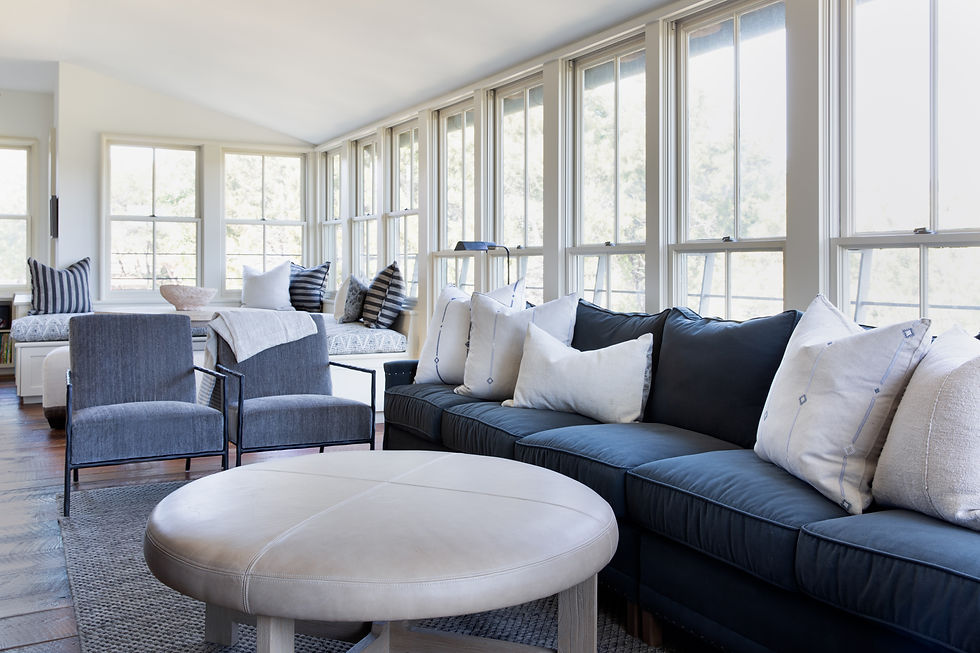
A dark sofa against a wall of windows in our Angelwylde project. Photography: Molly Culver
So instead of asking whether a small room requires a light sofa or a large room can handle a dark one, ask:
Does this room need the sofa to provide an anchor, or does the sofa need to step back and let something else lead?
Sometimes, of course, the room is asking for the sofa to be the star.
Choose a Color You Can Live With—Practically and Aesthetically
For a major sofa in a frequently used room, we often favor a neutral or complex mid-tone.
There is an obvious practical reason. Very light solid fabrics can reveal spills and dirt, while very dark solid fabrics can show lint, dust, and pet hair. Performance fabrics have made lighter upholstery considerably more realistic for active households than it once was.

Matching neutral sofas in a high-traffic room at this Frio River Family Retreat. Photography: Nick Johnson
But there is another kind of practicality that deserves just as much attention:
How easy will this sofa be to live with aesthetically ten years from now?
A sofa is expensive. It is much easier to experiment with vivid colors and patterns through pillows and smaller upholstered pieces than it is to reupholster—or replace—an entire sofa.
That doesn't mean we avoid colorful sofas. Far from it. We have used deep greens, rusts, blues, and other saturated colors when they were integral to the room.
The distinction is intentionality.
If you're going to bet big on a sofa color, there should be a compelling reason for it.
How To Choose a Sofa Color: Don't Choose Color Without Considering the Fabric
Color is only part of the equation.
For homes with children, pets, or frequent entertaining, texture and pattern can matter as much as the color itself. A woven fabric with subtle variation may live far more gracefully than a perfectly flat solid because everyday evidence of life does not announce itself quite so readily.
That is one reason looking at upholstery on a computer screen—or even choosing from a tiny swatch—can be misleading.
A two-inch fabric sample might seem understated in your hand. Stretch that same color across seven or eight feet of upholstery and it can become a significant visual statement.
Whenever possible, request the largest fabric sample available and bring it into the actual room. Look at it beside the rug, flooring, wall color, window treatments, and other important materials. Then look again in the morning, afternoon, and evening. Natural and artificial light can change undertones considerably.
For a significant investment—or when several major elements of a room are being selected at once—a professional rendering can also be invaluable. Seeing the sofa, rug, window treatments, art, and architecture together before making those commitments can prevent expensive mistakes.
Let the Room Tell You What the Sofa Should Be
There is no universally correct sofa color.
The right choice comes from understanding the room as a whole.
Before choosing a fabric, decide what you want the sofa to contribute. Should it create contrast? Quiet the room? Connect other colors? Ground an expansive space? Disappear against the architecture? Become a focal point?
And if the sofa is meant to make a statement, remember that color is only one tool available to you. Shape, proportion, tailoring, texture, craftsmanship, and architectural context can give even a quietly colored sofa enormous presence.
A good sofa does not need to shout to matter.
It simply needs to know its role in the room.

A shapely green sofa nestled into a cozy nook in the Breezeway Hill Manor. Photography: Chase Daniel / Styling: Stephanie Bohn.


